Guide
How to run a fair workout challenge with friends
Score showing up, not size. Give one point per tracked habit per day, judged against each person's own goal, so a beginner and a veteran start level. Keep each round short, 3 to 7 days, and run another when it ends. Write the rules down before day one: what counts as a workout, how rest days work, the daily cutoff and the tie-breaker. Keep it among friends, and never score bodyweight.
Why a challenge helps
A little friendly competition is one of the better-tested ways to nudge activity. In the STEP UP trial, 602 adults tracked their steps with a wearable for 24 weeks. Groups built around support, collaboration or competition all increased daily steps more than a control group, and competition increased them the most [1]. In a university trial, people who could compare their exercise-class attendance with peers attended about 90% more than those without comparison [2]. A points-based game among families also raised how often people met their step goals [3].
There is a catch. In STEP UP, activity dropped in every group once the game ended, though the competition group stayed above the control group [1]. A challenge is a nudge, not a fix. The aim is to turn the nudge into a habit before it fades.
Score showing up, not absolute numbers
The fastest way to ruin a challenge is to score raw numbers. Most pounds lifted, most steps or most weight lost all favor whoever is already biggest, fittest or has the most free time. Everyone else works out in the first two days that they can't win and stops trying.
Score whether each person did the thing they said they'd do:
- Use each person's own goal. In STEP UP, each participant set a step goal relative to their own baseline, and points came from hitting it [1]. A new lifter's 30-minute session counts the same as a veteran's.
- Keep the scoring simple. One point per tracked habit per day. Anyone can do the math, and nobody argues.
- Don't score bodyweight or body shape. Weight-loss contests can reward crash dieting and put people's bodies on a leaderboard. Score the behavior (trained, logged food, slept, checked in), not the body.
Consistency is also what builds a habit. A study of new gym members found that exercising at least four times a week for six weeks was the minimum to establish an exercise habit [4]. A scoring system that rewards turning up on most days pushes in that direction.
Keep rounds short: 3 to 7 days
A month-long challenge is easy to start and hard to finish. Someone gets sick in week two, falls behind, and the rest of the month is a formality. Short rounds fix that:
- Easy to commit to. Most people can promise three days or one week.
- A bad day doesn't end it. If you miss, the next round starts fresh in a few days.
- More finishes. Each round ends with a result, which is more fun than one winner after a month.
- Back-to-back rounds add up. Run weekly rounds for six weeks and you've covered the span the gym habit study points to [4].
Write the rules before day one
Arguments come from rules that were never written down. Agree on these before you start:
- What it tracks. Pick one to three habits. Workouts alone is a good first round. Add food, water, sleep or a daily check-in later if the group wants.
- What counts as a workout. Set a minimum, such as 30 minutes logged. Decide whether walks, classes or sport count.
- Rest days. Don't reward training every day. US guidelines call for muscle-strengthening activity on at least 2 days a week [5], and recovery is part of training. Let a short recovery session, such as stretching or a walk, earn the point on a couple of rest days a week.
- How it's proven. A log in a shared app is easier than screenshots in a group chat. Decide whether workouts typed in after the fact count.
- The daily cutoff. Midnight in whose time zone? Each person's own local day is simplest.
- The tie-breaker. For example, most full days where every tracked habit was done, then a shared rank.
- Stakes. Bragging rights are enough. Money and prizes can invite gaming the rules.
An example 7-day scoreboard
Made-up results for a round tracking workouts and sleep logging, worth up to 2 points a day and 14 for the week. Sam is new to lifting. Alex lifts five days a week.
| Friend | Workouts | Sleep | Total | Full days |
|---|---|---|---|---|
| Sam | 6 | 7 | 13 | 6 |
| Alex | 7 | 6 | 13 | 6 |
| Jordan | 5 | 7 | 12 | 5 |
Alex trained five times and used the recovery rule on the two rest days. Sam and Alex tie on points and on full days, so they share first place. The newest lifter kept pace with the most experienced one, because neither was scored on how much they lifted.
Keep it safe and friendly
- Sick or injured means rest. Nobody should train through an injury or illness to protect a streak. That is another reason short rounds work better.
- Keep it to people you know. A small group of friends keeps the stakes social rather than public.
- Share as little as possible. The group needs points, not your workouts, meals or weight.
- Check in with a professional if you need to. If you have a medical condition or are returning from an injury, ask a doctor or physical therapist what a sensible weekly target is for you.
How Apex Stacked competitions work
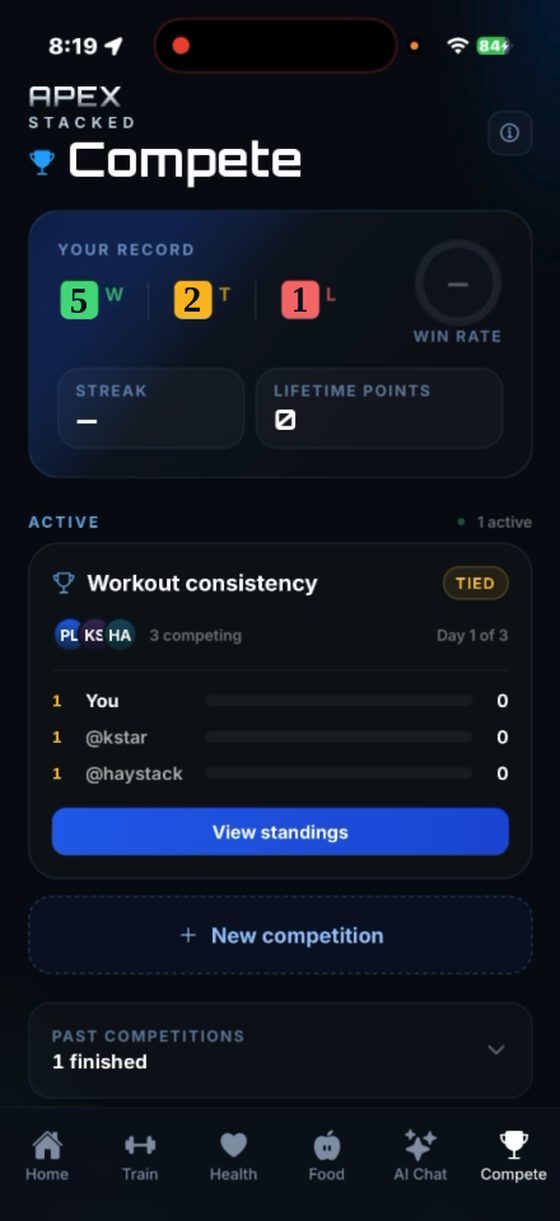
Apex Stacked competitions are built around the rules above, and they're free on every plan, on iPhone and Android.
- Friends only. Add friends by handle. There are no public or global leaderboards, no prizes, no wagering and no chat.
- 3 or 7 days. Start today, tomorrow or the day after. Results finalize 12 hours after the last day so everyone's points can sync.
- Choose what it tracks. Workout is the default. Add food, water, sleep or check-in, up to five items.
- One point per tracked item per day. Most points wins. Ties go to whoever completed the most full days, then a shared rank.
- Points for showing up. A workout of 30 minutes or more logged in Apex Stacked earns the day, and imported workouts don't count. On up to 2 rest days per 7 days, a recovery of 15 minutes or more counts instead. A food point means finishing within 10% of your own calorie and protein goals, and water means hitting your own water goal. Sleep and check-ins earn a point for logging them.
- No judging. Nobody is scored on how much they lift, what they eat or how big they are. Days roll over in each person's own time zone.
- Only totals are shared. Your handle, display name, points and how many days you fully completed. Your workouts, food and sleep logs stay on your phone.
- On your wrist. The Apple Watch app shows your running competition, your points and your rank. Competitions are created and joined on the phone.
Friends & Competitions is off until you turn it on, and it needs Sign in with Apple on iPhone or Google on Android. See fitness competitions.
Sources
- Patel MS, et al. Effectiveness of behaviorally designed gamification interventions with social incentives for increasing physical activity among overweight and obese adults across the United States: the STEP UP randomized clinical trial. JAMA Internal Medicine, 2019.
- Zhang J, et al. Support or competition? How online social networks increase physical activity: a randomized controlled trial. Preventive Medicine Reports, 2016.
- Patel MS, et al. Effect of a game-based intervention designed to enhance social incentives to increase physical activity among families: the BE FIT randomized clinical trial. JAMA Internal Medicine, 2017.
- Kaushal N, Rhodes RE. Exercise habit formation in new gym members: a longitudinal study. Journal of Behavioral Medicine, 2015.
- US Department of Health and Human Services. Top 10 things to know about the second edition of the Physical Activity Guidelines for Americans. Accessed October 18, 2026.