Guide
How to track calories and macros when you lift
Start with an estimated calorie target, then set protein first. Sports-nutrition position stands put protein for most people who train at roughly 1.2 to 2.0 g per kg of bodyweight a day, spread over several meals. Fill the rest with fat and carbs. Log everything you eat for a few weeks, weighing food and scanning barcodes where you can. Then adjust calories in small steps based on your weekly average bodyweight, not on any single morning.
Step 1: Pick a calorie starting point
Every calorie calculator gives an estimate, not a measurement. Many use the Mifflin-St Jeor equation, which predicts resting energy expenditure from weight, height, age and sex. In the original study it explained about 71% of the variation in measured resting energy use, so it is a good start but will be off for some people [1]. Calculators then add an allowance for activity, which adds more guesswork.
Treat the first number as a hypothesis. Eat at it for two or three weeks, log carefully, and let your bodyweight trend tell you whether it is right (see step 5).
- To maintain: eat at the estimate and check that your weekly average weight holds steady.
- To lose fat while keeping muscle: a review of natural bodybuilding contest prep recommends setting calories so bodyweight drops by about 0.5 to 1% a week [2].
- To gain muscle: a review of off-season bodybuilding nutrition suggests a surplus of about 10 to 20% and a gain of about 0.25 to 0.5% of bodyweight a week for novice and intermediate lifters, with advanced lifters aiming lower [3].
Step 2: Set protein first
Protein is the macro most tied to building and keeping muscle, so set it before anything else. Published ranges are expressed per kilogram of bodyweight per day (g/kg/day):
| Source | Daily protein | Who it applies to |
|---|---|---|
| ACSM, Academy of Nutrition and Dietetics and Dietitians of Canada joint position | 1.2 to 2.0 g/kg | Athletes, to support adaptation, repair and protein turnover [4] |
| International Society of Sports Nutrition (ISSN) position stand | 1.4 to 2.0 g/kg | Most exercising people, to build and maintain muscle [5] |
| ISSN position stand | 2.3 to 3.1 g/kg | Resistance-trained people during a calorie deficit, to retain lean mass [5] |
| Meta-analysis of 49 trials | About 1.6 g/kg | The point beyond which extra protein produced no further gain in fat-free mass, on average [6] |
If you think in pounds, divide your weight in pounds by 2.2 to get kilograms. For an 80 kg (176 lb) lifter, 1.4 to 2.0 g/kg works out to about 112 to 160 g of protein a day. Higher in the range is reasonable when you are cutting, since the evidence for higher intakes is strongest in a deficit [5].
Spread it across the day
The ISSN suggests about 0.25 g/kg of high-quality protein per meal, or 20 to 40 g, every 3 to 4 hours [5]. The joint ACSM position describes a similar pattern of about 0.3 g/kg after exercise and through the day [4]. In practice, three or four meals that each contain a solid protein source gets most people there.
Step 3: Split the rest between fat and carbs
Once protein is set, the remaining calories go to fat and carbohydrate. There is more room for personal preference here.
- Fat: the contest-prep review recommends 15 to 30% of calories from fat during a diet [2]. The off-season review suggests 0.5 to 1.5 g/kg a day [3]. Going very low for long periods makes meals harder to stick to and leaves less room for foods that carry essential fats.
- Carbohydrate: both reviews put the remaining calories here [2] [3]. The off-season review recommends at least 3 to 5 g/kg a day to support the energy demands of resistance training [3]. Many lifters find it easier to train hard with carbs in the meal before a session.
Protein and carbohydrate each provide about 4 calories per gram and fat about 9. If your app keeps calories equal to the sum of your macros, changing one macro will move the others.
A worked example
These numbers are made up to show the arithmetic. They are not a recommendation for you.
| Item | Choice | Grams | Calories |
|---|---|---|---|
| Calories | 80 kg lifter cutting, estimate of 2,600 at maintenance, start at 2,200 | n/a | 2,200 |
| Protein | 2.0 g/kg | 160 g | 640 |
| Fat | 25% of calories | 61 g | 550 |
| Carbohydrate | The remainder | 252 g | 1,010 |
Step 4: Log consistently
Targets only help if your log is close to what you actually ate. A systematic review of behavioral weight-loss studies found a consistent link between self-monitoring (food diaries, exercise logs and self-weighing) and weight loss, though the authors rated the evidence as weak because of study limitations [7]. Consistency matters more than perfection.
- Log as you go. Entering food at the meal is more accurate than reconstructing the day at night.
- Log the small stuff. Cooking oil, butter, sauces, dressings, drinks and the bites while cooking add up.
- Log the weekends. Skipping the hardest days makes your data look better than your intake.
- Repeat meals. Most people eat a small set of breakfasts and lunches. Save them once and reuse them.
Weigh food in grams
A cheap kitchen scale is more consistent than cups and spoons, especially for dense foods like rice, oats, nut butter and oil. Decide whether you weigh meat, rice and pasta raw or cooked, then match that to a food entry for the same state, and stick with it. Cooking changes water content, so mixing raw weights with cooked entries throws numbers off. You don't need to weigh forever. A few weeks teaches you what your usual portions look like.
Use barcodes, but check the entry
Scanning a barcode is the fastest way to log packaged food. Two caveats:
- Databases contain user entries. Open Food Facts, a common source, describes itself as a collaborative database run by a non-profit association of volunteers [8]. Check the serving size and the numbers against the package the first time you scan something.
- Labels are not exact. US rules treat a food as misbranded if its actual calories, total fat, saturated fat, sodium and some other nutrients are more than 20% above the label value, with some allowance for lab-method variability [9]. Labels are close enough for tracking. They are not lab measurements.
Small errors are fine as long as they are consistent. Step 5 corrects for them, because you adjust to what the scale does, not to what the log says.
Step 5: Adjust from your weekly bodyweight trend
Day-to-day scale weight moves with water, salt, food still being digested and training. A single weigh-in can mislead you. The trend over a week or more is what tells you whether your calorie target is working.
- Weigh yourself under the same conditions, for example after waking and using the bathroom, several mornings a week.
- Average each week's weigh-ins.
- Compare this week's average to last week's, as a percentage of bodyweight.
- If the rate is outside your target range for two weeks in a row, change calories by a small amount, such as 100 to 200 a day, mostly from carbs or fat. Keep protein where it is.
- Hold the new target for another two weeks before judging it.
A made-up example for the 80 kg lifter above, aiming to lose 0.5 to 1% a week (0.4 to 0.8 kg):
| Week | Average weight | Change | Decision |
|---|---|---|---|
| 1 | 80.0 kg | n/a | Baseline at 2,200 calories. |
| 2 | 79.4 kg | −0.75% | In range. Hold. |
| 3 | 79.2 kg | −0.25% | Slow. One week is not enough. Hold. |
| 4 | 79.1 kg | −0.13% | Slow two weeks running. Drop to 2,050 calories. |
If your weight changes but your training is also going badly, look at sleep, stress and how much of the deficit you are trying to take at once before cutting further.
Training days and rest days
Some lifters eat more carbs on training days and fewer on rest days, keeping protein the same. This can make hard sessions feel better and rest days easier to manage. It is optional. What matters most for body composition is your average intake across the week, so pick whichever approach you will stick to.
Not medical advice. This guide is general nutrition education for healthy adults who lift. It is not medical advice and is not a meal plan. If you have a medical condition such as kidney disease or diabetes, take medication that affects appetite or blood sugar, are pregnant or breastfeeding, or have a history of disordered eating, talk to a doctor or registered dietitian before changing how you eat. The joint ACSM position recommends that athletes see a registered dietitian for a personalized plan [4].
How Apex Stacked helps you track it
Apex Stacked is one app that keeps your food log next to your workouts, sleep, body measurements and bloodwork, so you don't need a separate macro app.
On the free plan you get barcode scanning against Open Food Facts. Products you've scanned before load from your phone first, so a repeat scan works offline, and if you correct a product's numbers, the next scan of that barcode returns yours. Every food you log saves to your library, and you can define a serving weight so a food can be logged in grams, ounces, milliliters or cups. You can copy a meal from one of your 14 most recent logged days and favorite up to 10 foods.
Macro setup starts from a Mifflin-St Jeor estimate, then every value is editable. Lock the fields you want to keep and the rest rebalance, so calories always equal your macros. When your logged weight or activity no longer matches your targets, an amber banner previews new numbers and changes nothing until you confirm. Weight and body fat logging with 30-day trend charts is free. See the macro tracker.
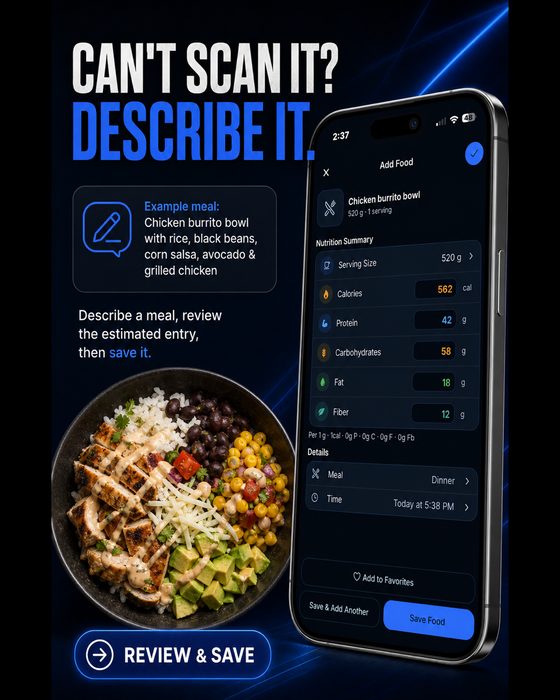
Apex Pro ($2.99 a month or $24.99 a year) adds macro and water targets by weekday, so training and rest days can differ, plus nutrition label scanning that reads the panel on your phone and unlimited favorites. Apex Pro + AI ($8.99 a month, with a 7-day trial) lets you describe or speak a meal for an estimate you review before saving. Apex Stacked does not recognize meals from photos. See pricing.
Sources
- Mifflin MD, St Jeor ST, et al. A new predictive equation for resting energy expenditure in healthy individuals. American Journal of Clinical Nutrition, 1990.
- Helms ER, Aragon AA, Fitschen PJ. Evidence-based recommendations for natural bodybuilding contest preparation: nutrition and supplementation. Journal of the International Society of Sports Nutrition, 2014.
- Iraki J, Fitschen P, Espinar S, Helms E. Nutrition recommendations for bodybuilders in the off-season: a narrative review. Sports, 2019.
- Thomas DT, Erdman KA, Burke LM. American College of Sports Medicine Joint Position Statement: Nutrition and athletic performance. Medicine & Science in Sports & Exercise, 2016.
- Jäger R, et al. International Society of Sports Nutrition position stand: protein and exercise. Journal of the International Society of Sports Nutrition, 2017.
- Morton RW, et al. A systematic review, meta-analysis and meta-regression of the effect of protein supplementation on resistance training-induced gains in muscle mass and strength in healthy adults. British Journal of Sports Medicine, 2018.
- Burke LE, Wang J, Sevick MA. Self-monitoring in weight loss: a systematic review of the literature. Journal of the American Dietetic Association, 2011.
- Open Food Facts. Discover the project. Accessed October 18, 2026.
- US Code of Federal Regulations. 21 CFR 101.9(g)(5), Nutrition labeling of food. Accessed October 18, 2026.