Guide
Progressive overload explained, with an example week
Progressive overload means making your training a little harder over time so your body keeps a reason to adapt. You can add weight, reps, sets, range of motion or density. A simple, well-supported method is double progression: work up to the top of a rep range at one weight, then add a small amount of load and start again from the bottom of the range.
What progressive overload is
Your muscles adapt to the work you give them. Once a workout stops being hard, it stops pushing much new adaptation. The American College of Sports Medicine (ACSM) position stand on resistance training says progressive protocols are needed "to stimulate further adaptation toward specific training goals" [1].
Overload does not mean adding weight every session. It means the demand rises over weeks and months, in steps small enough that you can keep good form and recover between sessions.
Five ways to progress
- Load. Lift more weight for the same reps. ACSM suggests a 2 to 10% increase once you can do one or two reps more than your target with the current load [1].
- Reps. Do more reps with the same weight. In an 8-week trial with trained lifters, adding reps at a fixed load and adding load at a fixed rep range produced similar gains in muscle size and strength [2].
- Sets (volume). Add a set to an exercise or a muscle's week. A meta-analysis found a graded dose-response: more weekly sets were linked to more muscle growth, within the range studied [3]. Add sets slowly, since each one also adds fatigue.
- Technique and range of motion. Lowering under control, pausing, or using a fuller range makes the same weight harder. This counts as progress, so note it in your log.
- Density. Do the same work in less time, usually with shorter rests. Use this with care for heavy lifts. ACSM recommends longer rests (3 to 5 minutes) for heavy strength work and 1 to 2 minutes for hypertrophy-style sets [1].
Most lifters only need the first two. Load and reps are easy to measure and easy to compare from one session to the next.
Double progression, step by step
Double progression uses reps first, then load. It matches the ACSM guidance of adding weight after you beat your target reps [1].
- Pick a rep range for the lift, such as 8 to 12.
- Choose a weight you can lift for the bottom of the range on every set, with one to three reps left in reserve.
- Each session, try to add a rep to one or more sets at the same weight.
- When every set reaches the top of the range, add the smallest practical jump in weight. That is often 5 lb on upper-body barbell lifts, 5 to 10 lb on lower-body lifts, or the next dumbbell.
- With the new weight your reps will drop toward the bottom of the range. Build them back up and repeat.
A worked example: bench press, 3 sets of 8 to 12
These numbers are made up to show the pattern.
| Session | Weight | Reps (set 1, 2, 3) | RIR on last set | Decision |
|---|---|---|---|---|
| 1 | 135 lb | 12, 10, 9 | 1 | Not all sets at 12. Hold the weight. |
| 2 | 135 lb | 12, 11, 10 | 1 | Two more reps than last time. Hold. |
| 3 | 135 lb | 12, 12, 12 | 2 | Top of the range on every set. Go to 140 lb next time. |
| 4 | 140 lb | 10, 9, 8 | 1 | Back near the bottom of the range. Start building reps again. |
The jump from 135 to 140 lb is about 4%, inside the ACSM range of 2 to 10% [1]. Total reps went from 31 to 33 to 36 before the jump. That is progress, even though the bar weight stayed the same for three sessions.
Using reps in reserve to judge effort
Reps in reserve (RIR) is how many more good reps you think you could have done at the end of a set. RIR 0 means you could not have done another. RIR 2 means two more were left. Researchers built a resistance-training effort scale around this idea, where RPE 10 equals 0 RIR, RPE 9 equals 1 RIR, and so on [4].
RIR helps you pick the right weight and decide when to add load. If a set at the top of your range still felt like RIR 3 or more, the weight is light. If you hit 0 RIR early in a session, it may be too heavy to progress cleanly.
Estimates are not perfect. A meta-analysis found people underestimated the reps they had left by about one rep on average, with wide variation. Accuracy was better on sets of 12 reps or fewer and closer to failure [5]. So treat RIR as a useful guide, and log it every time so you learn your own bias.
How to log so progress is visible
Progressive overload only works if you can see what you did last time. A good log makes the next decision obvious.
- Use the same exercise names. "Bench press" and "flat barbell bench" split one lift into two histories. Pick one name and keep it.
- Record every working set. Weight, reps, and RIR for each set, not only the best one.
- Mark warm-ups and special sets. Keep warm-ups out of your working totals. Mark drop sets or paused reps so you compare like with like.
- Note what changed. A new bench, a different grip, or a fuller range all change the numbers.
- Add context. Bodyweight, last night's sleep, and how your energy felt. These help explain a bad day so you don't misread it as a plateau.
An example week: 3-day full body
This is a generic example for a lifter with some experience, training three non-consecutive days a week. ACSM suggests 2 to 3 days a week for novices and 3 to 4 for intermediates [1]. Swap exercises for ones that suit your equipment and body.
| Day | Exercise | Sets × reps | Target RIR | How to progress |
|---|---|---|---|---|
| Mon | Back squat | 3 × 5–8 | 2 | Double progression. Add 5–10 lb when all sets hit 8. |
| Mon | Bench press | 3 × 6–10 | 1–2 | Double progression. Add 5 lb when all sets hit 10. |
| Mon | Chest-supported row | 3 × 8–12 | 1–2 | Add reps, then the next weight. |
| Mon | Plank | 3 × 30–45 s | n/a | Add 5 s per set until 45 s, then a harder variation. |
| Wed | Romanian deadlift | 3 × 6–10 | 2 | Double progression. Add 5–10 lb when all sets hit 10. |
| Wed | Overhead press | 3 × 6–10 | 1–2 | Smaller jumps. Add 2.5–5 lb when all sets hit 10. |
| Wed | Lat pulldown | 3 × 8–12 | 1–2 | Add reps, then the next pin. |
| Wed | Walking lunge | 2 × 8–12 per leg | 2 | Add reps, then heavier dumbbells. |
| Fri | Leg press | 3 × 10–15 | 1–2 | Add reps, then load. Keep the same depth. |
| Fri | Incline dumbbell press | 3 × 8–12 | 1–2 | Move to the next dumbbell when all sets hit 12. |
| Fri | Seated cable row | 3 × 10–15 | 1 | Add reps, then the next pin. |
| Fri | Leg curl | 2 × 10–15 | 1 | Add reps, then load. Add a third set after a few weeks if recovery is good. |
Big compound lifts use lower rep ranges and a bit more reserve, since form breaks down first on them. Smaller exercises use higher ranges and can go closer to failure. Most of these ranges sit within the 6 to 12 rep zone ACSM emphasizes for hypertrophy [1].
When progress stalls
Every lifter stalls. One flat session means little. If a lift has not moved in reps or load for two or three weeks, work through this list before changing the whole program.
- Sleep. A systematic review found that several nights of short sleep could reduce force on multi-joint lifts, though one night without sleep had little effect [6]. Check your log for a pattern.
- Food. Eating too little makes progress harder. In a meta-analysis, protein supplementation increased gains in strength and muscle, with no further gain in fat-free mass beyond about 1.6 g of protein per kg of bodyweight per day [7].
- Recovery and stress. Work, travel and illness all show up in the gym. Your notes on energy will show this.
- Volume. If you are always sore and flat, cut a set from the stalled lift or its accessories. If you recover easily and still stall, try adding one set.
- Deload. Take a lighter week, then return to your normal training.
What a deload is, and how strong the evidence is
A deload is a planned period of easier training. An expert consensus defines it as "a period of reduced training stress designed to mitigate physiological and psychological fatigue, promote recovery, and enhance preparedness for subsequent training" [9]. In interviews, coaches most often cut volume (fewer sets and reps) and effort (more reps in reserve or less load), usually for 5 to 7 days every 4 to 6 weeks, though timing varied a lot [8].
Deloads are common, but they are under-researched [9]. In one trial, trained lifters who took a full week off midway through a 9-week program gained the same muscle size as those who kept training, but gained a little less lower-body strength [10]. That study stopped training completely, which is not how most lifters deload. A reasonable reading: a deload is a sensible tool for managing fatigue when you feel run down, not a magic fix, and you don't need one on a fixed schedule if you are progressing well.
Safety
Learn each lift with good form before you push the weight. Progress in small steps. Stop a set if your form breaks down or you feel sharp pain. If you are injured, have a medical condition, or are new to lifting, talk to a doctor, physical therapist, or qualified coach before starting.
How Apex Stacked helps you track it
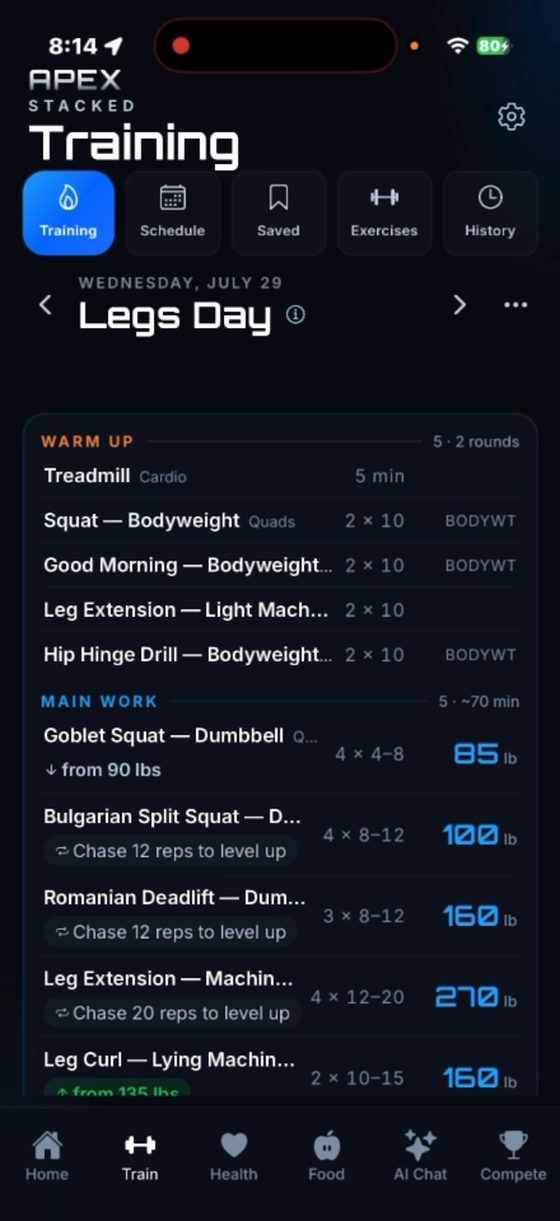
Apex Stacked is one way to run this method without doing the math by hand.
On the free plan, your saved workouts get their next weights from progressive overload. When the load is held, the lift shows a "chase reps" target. You can log every set type (warm-up, working, to failure, drop and pause), record RIR after your last working set, and see PRs on four axes: estimated 1RM, heaviest weight, rep PR and best total. See the workout tracker.
Apex Pro ($2.99 a month or $24.99 a year) builds a training week around your split, schedule and equipment, on your phone with no AI. It plans overload across the whole week, checks your history for when a deload is due, and builds the deload week for you. Deload detection is part of Apex Pro, not the free plan. See training plans.
Sources
- American College of Sports Medicine. Position stand: Progression models in resistance training for healthy adults. Medicine & Science in Sports & Exercise, 2009.
- Plotkin D, et al. Progressive overload without progressing load? The effects of load or repetition progression on muscular adaptations. PeerJ, 2022.
- Schoenfeld BJ, Ogborn D, Krieger JW. Dose-response relationship between weekly resistance training volume and increases in muscle mass. Journal of Sports Sciences, 2017.
- Zourdos MC, et al. Novel resistance training-specific rating of perceived exertion scale measuring repetitions in reserve. Journal of Strength and Conditioning Research, 2016.
- Halperin I, et al. Accuracy in predicting repetitions to task failure in resistance exercise: a scoping review and exploratory meta-analysis. Sports Medicine, 2022.
- Knowles OE, et al. Inadequate sleep and muscle strength: implications for resistance training. Journal of Science and Medicine in Sport, 2018.
- Morton RW, et al. A systematic review, meta-analysis and meta-regression of the effect of protein supplementation on resistance training-induced gains in muscle mass and strength in healthy adults. British Journal of Sports Medicine, 2018.
- Bell L, et al. Coaches' perceptions, practices and experiences of deloading in strength and physique sports. Frontiers in Sports and Active Living, 2022.
- Bell L, et al. Integrating deloading into strength and physique sports training programmes: an international Delphi consensus approach. Sports Medicine - Open, 2023.
- Coleman M, et al. Gaining more from doing less? The effects of a one-week deload period during supervised resistance training on muscular adaptations. PeerJ, 2024.