Guide
How to track a TRT protocol and your bloodwork together
Keep two linked logs: one entry for every injection or application (date, time, the amount as prescribed, route, site and notes), and one entry for every blood draw (date, time, hours since your last dose, fasting status, lab, values, units and the lab's printed reference range). Draw at the time your clinician specifies, ideally at the same lab each time, so results are comparable. Bring a short summary to each appointment, and leave every dose and protocol decision to your prescriber.
This guide is about records, not treatment. It does not suggest doses, schedules, products or target numbers. Your prescribing clinician decides those. What you can do is keep a record clear enough that your clinician can read your results in context, and that you can follow over months and years.
Why the two logs belong together
A lab value on its own is missing context. On testosterone therapy, the number you get back depends partly on when blood was drawn relative to your last dose. The Endocrine Society guideline gives formulation-specific timing for checking testosterone during treatment. For enanthate or cypionate injections it says to measure midway between injections, for injectable undecanoate just before the next injection, and for gels a set number of hours after application [1]. Your clinician may use a different plan, and theirs is the one to follow.
Either way, the lab report will not tell anyone when your last dose was. Only your dose log can. Linking the two is what turns a pile of results into a readable history.
Ongoing monitoring is a normal part of treatment. Both the Endocrine Society and the American Urological Association (AUA) describe follow-up testing after therapy starts and then at regular intervals [1][2]. Cleveland Clinic notes that once you start TRT you will have regular appointments and routine blood tests, and that your provider will tell you how often [3].
What to record for each dose
Log every dose at the time you take it. Memory is unreliable after a week, and the details matter later.
- Date and time. The time is what lets you work out the gap between a dose and a blood draw.
- Amount, exactly as prescribed. Copy the amount and unit from your prescription or pharmacy label. If you took something different from the prescription, write down what actually happened and tell your clinician. Do not change it on your own.
- Formulation and route. For example, the product name on the label and whether it is an injection, gel or another form.
- Site. For injections or topical applications, note where. It helps you rotate as instructed and spot a pattern if a site gives you trouble.
- Vial or batch. Note when you start a new vial or pharmacy fill. It is useful if a question about a particular supply ever comes up.
- Skipped or late doses. Record these too. A missed dose near a blood draw changes how that result should be read.
- Notes. Anything unusual: a site reaction, illness, travel, or a change your clinician made.
What to record for each blood draw
Record these the day of the draw, then add the values when the report arrives.
- Date and time of the draw. MedlinePlus notes that testosterone tests are often drawn in the morning, when levels are typically highest [4].
- Time since your last dose. Calculate it from your dose log and write it next to the result.
- Fasting or not. Some tests need fasting, and you may be told to pause certain medicines beforehand [4]. Follow your provider's instructions and note what you did.
- Lab name. Results from different labs are often not directly comparable [5].
- Each marker's value and unit. Copy the unit exactly as printed.
- The reference range printed on that report. Labs often use different reference ranges, so the range on your own report is the one that applies to that result [5].
- Any flags the lab printed, such as high or low.
- Context. Recent illness, a hard training block, poor sleep or a missed dose.
Which markers tend to show up
Your clinician chooses your tests, so let your own orders guide what you log. For reference, these are the ones the guidelines and labeling discuss:
- Testosterone. Rechecked during treatment, timed by formulation [1][2].
- Hematocrit or hemoglobin. Testosterone can raise red blood cell counts, and both guidelines call for checking it at baseline and periodically during treatment [1][2][3]. The prescribing information for testosterone cypionate also says hemoglobin and hematocrit should be checked periodically [6].
- PSA. Both guidelines discuss prostate monitoring, depending on age and history [1][2].
- Others your clinician orders. The AUA table also covers LH, FSH, prolactin and estradiol in specific situations [2], and the cypionate label notes that serum cholesterol may increase during androgen therapy [6].
A simple example log
A spreadsheet, a notebook or an app all work. What matters is the columns. The rows below are placeholders, not suggestions.
Dose log
| Date | Time | Amount | Route / site | Vial | Taken? | Notes |
|---|---|---|---|---|---|---|
| YYYY-MM-DD | HH:MM | As prescribed | Route, site as instructed | Vial A | Taken | None |
Lab log
| Draw date / time | Since last dose | Fasting | Lab | Marker | Value + unit | Printed range |
|---|---|---|---|---|---|---|
| YYYY-MM-DD HH:MM | [hours] | Yes / No | Lab name | Total testosterone | [value] [unit] | [range from report] |
Keep draw timing consistent
A trend is only meaningful if the points were measured the same way. If one result was drawn the morning after a dose and the next one late in the cycle, a change in the number may say more about timing than anything else.
- Ask your clinician exactly when to draw relative to your dose, and write the instruction down.
- Schedule the draw from your dose log, not from memory.
- If a draw happens at a different point than usual, keep the result but mark it clearly so nobody compares it as if it were like the others.
Comparing results across labs
People switch labs because of insurance, travel or convenience. That is fine, but it complicates the record. Labs can report the same test in different units and with different reference ranges, and MedlinePlus cautions that results from different labs often cannot be compared directly [5]. The AUA's baseline guidance is to measure total testosterone at the same lab with the same assay [2].
- Use one lab when you can.
- Always store the unit and the printed range with each value, never the number alone.
- If you convert units for a chart, keep the original value too.
- When you change labs, flag the first result from the new lab in your notes.
Keep short symptom and energy notes
Guidelines say clinicians should evaluate how you respond after treatment starts, including side effects [1]. Cleveland Clinic lists reasons to see your provider, such as symptoms that do not improve or side effects that bother you [3]. Short notes help you describe this accurately.
Keep it brief and consistent. A weekly line with a simple rating for energy, sleep, mood and libido, plus anything new, is enough. Record what you notice, not what you think caused it. Your clinician can weigh it against your labs and history.
Prepare a summary for appointments
A one-page summary saves time and keeps the visit focused. Include:
- Your current prescription as written, and any changes since the last visit.
- Adherence: missed, late or extra doses since the last visit.
- Each recent lab result with date, time since last dose, lab name, unit and printed range.
- The previous result for the same markers, so the change is visible.
- Symptom notes and any side effects.
- Your questions, written down in advance.
Then let your clinician interpret it. MedlinePlus stresses that your provider looks at your other health information to understand what your results mean for you [5].
How Apex Stacked helps
Apex Stacked is one way to keep both logs in one place. It is a tracking tool. It records the protocol you enter and never recommends a dose, a change or a source.
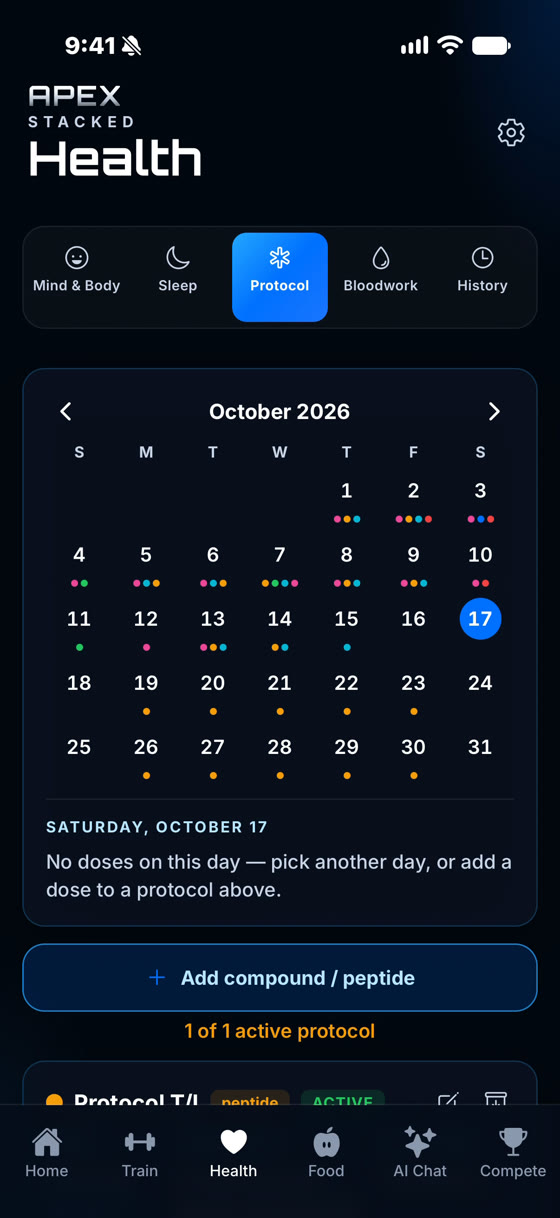
- Protocols. Choose a type (TRT, peptide, supplement or other) and enter the amount, unit and schedule you were given. Log each dose as taken or skipped, including ones you forgot to log on the day. Peptide & TRT tracker
- Reminders. Reminders follow your schedule and stop for the day once you log or skip that dose. Discreet notifications show only a generic reminder on your lock screen.
- Vial tracking. See doses left and amount remaining, get a low-vial reminder, and start a new vial when you open one.
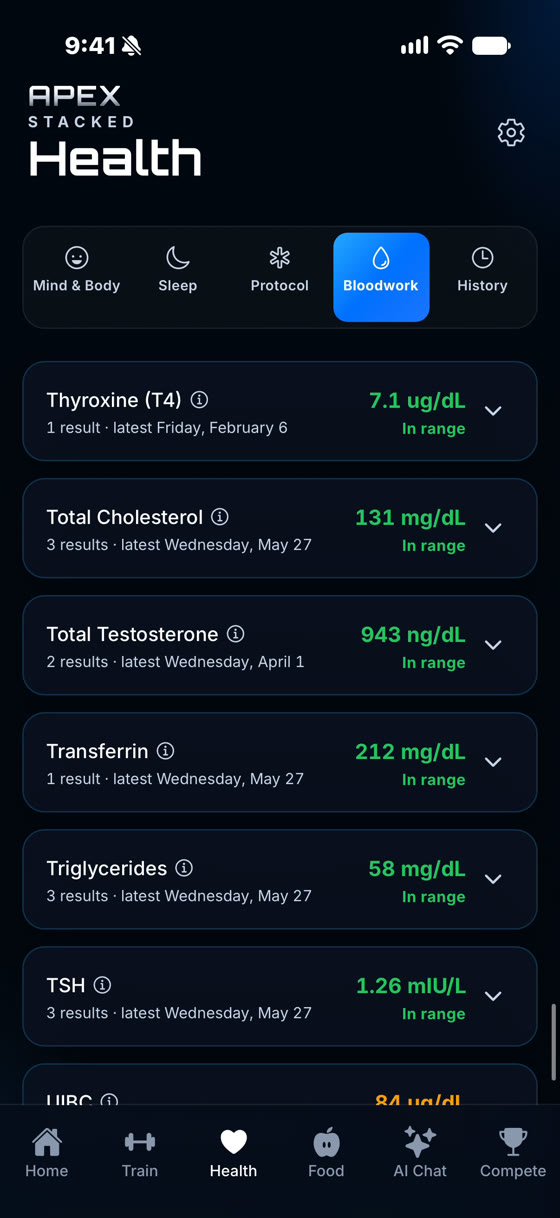
- Bloodwork, entered by hand for free. Type in values with the lab name and collection date. Your lab's printed reference range is used when it is on the report. Bloodwork tracker
- Trends. After a second test, each marker gets a trend line. Mixed units such as nmol/L and ng/dL are converted so the line stays continuous, and anything that cannot be converted is shown as recorded and flagged.
- Lab report scanning (Apex Pro + AI). Photograph or upload a report. Your name, date of birth and other identity details are blacked out on your phone before anything is sent, and you review every value before saving.
- Marker explanations. Tap a marker for a plain-language note on what it generally measures. It never interprets your own value.
- AI coach. On Apex Pro + AI, the coach can read your protocols and labs when you ask about your numbers. It does not recommend doses, changes or sources.
The free plan includes one active protocol with logging, reminders and vial tracking, plus manual bloodwork entry and trends. Apex Pro removes the limit on active protocols. Scanning needs Apex Pro + AI or the Apex AI add-on. See pricing.
Health disclaimer. This guide is general information about keeping records. It is not medical advice and does not recommend any dose, schedule, product or target value. Decisions about your testosterone therapy, including dose, timing and which labs to order, belong to your prescribing clinician. Talk to them about what your results mean for you.
Sources
- Bhasin S, et al. Testosterone Therapy in Men With Hypogonadism: An Endocrine Society Clinical Practice Guideline. Journal of Clinical Endocrinology & Metabolism, 2018. See Table 9, monitoring men receiving testosterone therapy.
- American Urological Association. Evaluation and Management of Testosterone Deficiency (2018, validity confirmed 2024), and its Table 7: Follow-up Laboratory Testing.
- Cleveland Clinic. Testosterone Replacement Therapy (TRT).
- MedlinePlus, U.S. National Library of Medicine. Testosterone Levels Test.
- MedlinePlus, U.S. National Library of Medicine. How to Understand Your Lab Results.
- DailyMed, U.S. National Library of Medicine. DEPO-TESTOSTERONE (testosterone cypionate) injection, prescribing information, Laboratory Tests section.