Guide
How to track your bloodwork trends over time
Record every result with its date, the lab that ran it, the unit and the lab's printed reference range, plus the conditions of the draw, such as fasting and time of day. Test at the same lab under the same conditions when you can, and compare a marker only in one unit. Then bring the whole record to your clinician, who interprets what the changes mean for you.
Why one result is only a snapshot
A single blood test shows one moment. Your body is always changing, and diet, activity, hormonal cycles and even the season can shift results in healthy people [2]. Each person's results also move around their own usual level from day to day, which lab scientists call within-subject biological variation [4].
The measurement itself adds some noise too. Lab scientists call this analytical variation, the imprecision of the test [4]. Results from one person vary over time because of three things: how the sample was collected and handled, the measurement, and that person's own biology [4].
That is why a series of results is more useful than any one of them. Testing.com notes that a rise or drop in a marker can matter even when both results sit inside the normal range [2]. Whether a change matters is your clinician's call, but they can only judge a trend if the results have been kept.
Reference ranges belong to the lab, not the marker
There is no universal reference range. Each lab sets or validates its own, so ranges differ from lab to lab [2]. A lab report usually lists your result followed by that lab's range for each test [2], and your result should be read against the range from the lab that ran it [2].
Ranges are commonly built to cover 95% of results from a healthy population [2]. So it is common for healthy people to sometimes have a result outside the range [1]. A flag on a report is a reason to ask, not a conclusion.
For your records, the practical rule is simple. Copy the printed range next to every result, every time. Do not reuse last year's range or a range from a website.
Compare results in the same unit
Units are an easy way to break a trend line. In the US, most lab results are reported in conventional units, which express concentration as mass per volume, such as milligrams per deciliter. Most of the rest of the world uses SI units, which express it in moles per liter [6].
The same marker can therefore appear with very different numbers. Labcorp's conversion table lists testosterone in ng/dL or nmol/L, and glucose and cholesterol in mg/dL or mmol/L, each with its own conversion factor [7]. A value of a few hundred in one unit and a value in the teens in another may describe the same level.
- Always write the unit next to the value.
- Convert to one unit before comparing, using the lab's or a reference lab's factor for that specific marker [7].
- Convert the reference range with the same factor, or keep the original range in the original unit.
- If you are unsure a marker can be converted, keep it as reported and note the difference.
Record the conditions of each draw
Many things outside your long-term health can change a result. MedlinePlus lists these among them [1]:
- Eating and drinking certain foods and drinks.
- Taking certain medicines or supplements.
- Exercising hard before the test.
- Having a menstrual period at the time of the test.
- Whether you followed preparation instructions, including fasting.
A few of these deserve a note in your log.
Fasting
Fasting means no food or drink except water, for up to several hours or overnight [3]. For a cholesterol test, you may be asked to fast for 9 to 12 hours, and your provider will tell you whether you need to [9]. Record whether you were fasted and roughly how long.
Time of day
Some markers follow a daily rhythm. MedlinePlus says testosterone is usually drawn in the morning, between 7 and 10, when levels are typically highest [5]. Record the draw time so you can compare like with like.
Hard exercise
Strenuous exercise is one of the behaviors some tests ask you to avoid beforehand [3]. If you lifted hard or did a long session in the day or two before, write it down.
Hydration
How hydrated you are can affect some results, including hematocrit [8], and for some blood tests you may be asked to drink extra water beforehand [3]. A short note such as "well hydrated" or "low on fluids" is enough. Don’t use it to explain away a high result, though. Other things raise hematocrit too, including testosterone therapy (see tracking TRT and bloodwork), so a high value is a question for your clinician.
Medicines and supplements
Some tests ask you to avoid certain medicines or supplements, but you should not stop a medicine unless your provider tells you to [3]. Tell your provider about everything you take [5]. The FDA warns that biotin, which is often found in supplements, can interfere with certain lab tests and cause incorrect results that may go undetected [10]. List each medicine and supplement, with dose, for every draw.
Small changes may not mean much
Because of biological and analytical variation, two results can differ even when nothing important has changed. Lab scientists use a calculation called the reference change value to judge whether the difference between two of one person's results is larger than that background noise [4]. You do not need to do that math. The practical point is to avoid reading too much into one small move, and to let your clinician decide what is meaningful.
You can reduce the noise you control:
- Use the same lab when you are looking for trends [1]. Testing.com also notes that the same lab may be recommended for consistency [2].
- Draw at about the same time of day.
- Match fasting status, recent training, and hydration from test to test.
- Follow the preparation instructions exactly, since even a minor change can have a big effect on results [3].
What to record for every draw
MedlinePlus suggests keeping your own personal health record, including dates and results of tests and a list of your medicines and supplements with doses [11]. For bloodwork, that comes down to this list:
- Collection date and time (the draw date, not the report date).
- Lab name.
- Each marker exactly as named on the report.
- Value and unit.
- The lab's printed reference range, in the same unit.
- Any flag the lab printed, such as H or L.
- Fasted or not, and for how long.
- Training in the previous day or two.
- Hydration, and anything unusual that day.
- Medicines and supplements, with doses.
- For those who menstruate, where you were in your cycle.
Keep the original report as well. A tracker is a copy, and copies can contain typing errors.
A simple tracking table
A spreadsheet works fine. Put one row per marker per draw, so new tests add rows rather than columns. The example below uses placeholders, not real values.
| Date and time | Lab | Marker | Value | Unit | Lab range | Conditions |
|---|---|---|---|---|---|---|
| Jan 10, 8:00 am | Lab A | Marker 1 | [value] | [unit] | [low] to [high] | Fasted 12 h, rest day, no new supplements |
| Jan 10, 8:00 am | Lab A | Marker 2 | [value] | [unit] | [low] to [high] | Same draw |
| Apr 12, 8:15 am | Lab A | Marker 1 | [value] | [unit] | [low] to [high] | Fasted 12 h, hard leg session the day before |
| Apr 12, 8:15 am | Lab A | Marker 2 | [value] | [unit] | [low] to [high] | Same draw |
With the table in this shape, you can filter by marker and chart value against date. Add a column for the converted value if any of your labs report in a different unit.
Preparing for a clinician visit
MedlinePlus advises talking with your provider about what your results mean for you, even when they are normal [1]. A clean record makes that conversation faster.
- Bring the original reports and your tracking table or chart.
- Point out any lab change, unit change or unusual draw conditions.
- Bring your current list of medicines and supplements, with doses [11].
- Write your questions down before the visit, for example "Is this change something we should watch?" and "Should I prepare differently next time?"
- Ask when the next test should be and whether it should be fasted.
How Apex Stacked helps
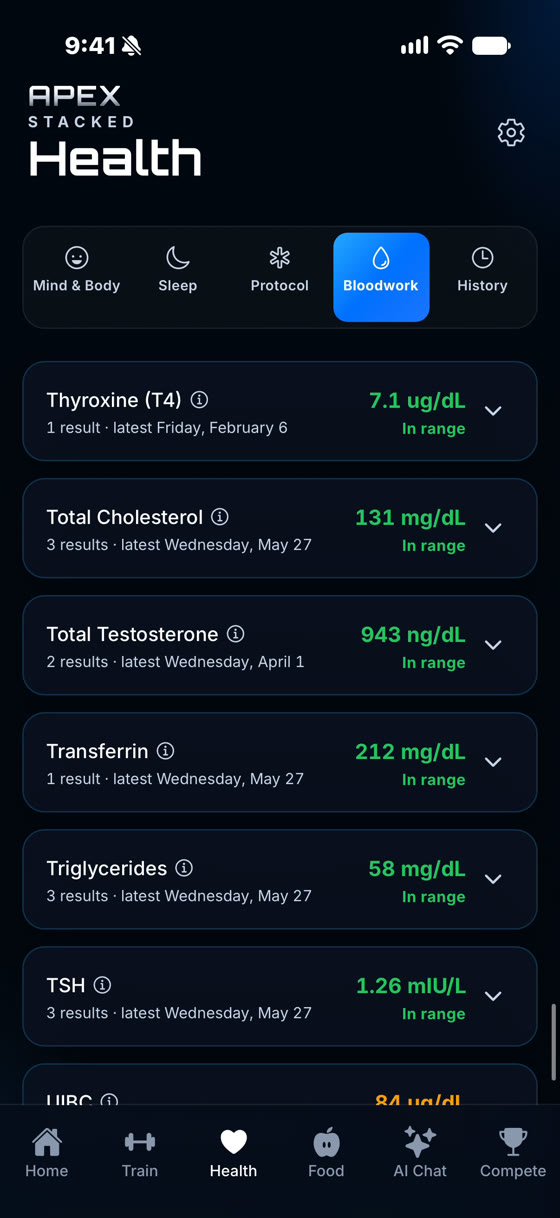
Apex Stacked is one way to keep this record on your phone. The bloodwork tracker does the following:
- Free manual entry. Type in values with the lab name and collection date.
- Markers. 32 built-in markers in six groups (hormones, lipids, metabolic, CBC, organ health and thyroid), plus custom markers named exactly as they appear on your report.
- Trend charts. From your second test, each marker gets a chart across your test dates, with past results listed underneath.
- Units. Mixed units, such as nmol/L and ng/dL, are converted to one unit where possible. Anything that can't be converted is shown as recorded and flagged.
- Ranges and flags. Your lab's printed range is used when it is on the report. Otherwise the app falls back to a built-in range. Values above or below the range are flagged.
- Next test. Set your next bloodwork date for a countdown and reminder, with a Fasted flag.
- Scanning. Scan a lab report from photos, or upload a PDF on iPhone only. Your name, date of birth and other identity details are blacked out on your phone before anything is sent, and you review every value before saving. Scanning needs Apex Pro + AI, or the Apex AI add-on on an Apex Pro plan. See pricing.
- Marker explanations. A plain-language description of what a marker generally measures. Common markers are covered offline for free, and unfamiliar markers are explained by the AI with Apex Pro + AI. Explanations never interpret your own value.
Health disclaimer
This guide is for education and recordkeeping only. It does not explain what any result means for you, and it is not medical advice. Do not change a medicine, supplement or protocol based on a trend you see. Discuss your results with a qualified clinician.
Sources
- How to Understand Your Lab Results, MedlinePlus, National Library of Medicine.
- Reference Ranges and What They Mean, Testing.com (formerly Lab Tests Online).
- How to Prepare for a Lab Test, MedlinePlus, National Library of Medicine.
- Pearls of Laboratory Medicine: Biological Variation, Association for Diagnostics & Laboratory Medicine (ADLM).
- Testosterone Levels Test, MedlinePlus, National Library of Medicine.
- Conversion Tables, Merck Manual Professional Version.
- SI Unit Conversion Table, Labcorp.
- Hematocrit Test, MedlinePlus, National Library of Medicine.
- Cholesterol Levels, MedlinePlus, National Library of Medicine.
- Biotin Interference with Troponin Lab Tests, US Food and Drug Administration.
- Personal Health Records, MedlinePlus, National Library of Medicine.